Showing posts with label growing fruit. Show all posts

Tuesday, February 23, 2016

Apple Pruning and Saving Scionwood

A freshly pruned Stayman Winesap
Today was a lovely day - dry, warm and time to prune the apple trees.  This winter was so warm for so long, I feared our apple trees might bloom in the middle of winter like some of the street trees in Pittsburgh, but luckily, it finally got cold and that didn't happen.

I have our apple trees planted in a hedgerow, at fairly close spacing, loosely experimenting with the idea of Backyard Orchard Culture from Dave Wilson Nursery and others.  I found this a helpful synopsis of the pruning ideas, if you scroll down through all the "why to do it" stuff.   This idea of forcing trees to compete for nutrients and keeping them small through lots of extra pruning isn't my usual planting philosophy, but it makes sense to me to try it in this context.  I want a tree I can easily reach to spray with my holistic foliar sprays, and easily prune and harvest without an orchard ladder.  I want the trees to grow closely in a mixed hedgerow with other plants to keep out the deer, and I don't want to just use a dwarf rootstock because they are short lived and not good at anchoring so they would have to be supported and staked on our windy hillside.  So far, so good (trees are 2 -3 years old) but we shall see how it goes as they continue to grow.  This is something I am prepared to fail at, though I hope I don't for the trees' sake. 

All my trees are on EMLA 111 Rootstock, a large semi-dwarf that if allowed to grow full size would reach 20'.  I'm attempting to keep them pruned to 10 - 12'.  This means spring and summer pruning the first few years that pretty much removes half of all new growth.  Pruning fruit trees is hard for the uninitiated...it seems so damn complicated.  Reading, reading, reading the 400 different theories of how to do it, thinking about what feels right, and then just going for it is the only way to learn.  I'm still in the beginning of the learning curve, but each year I figure things out...so we shall see how these trees respond to what I've done now that we are in year three.

Arkansas Black with minimal pruning
The varieties I have planted include:
  • Stayman Winesap (this tree has a lovely, open growth habit)
  • Arkansas Black
  • Zestar! (definitely the oddball in my collection of older varieities - this is a patented variety whose growth habit seems very unfortunate - like the Grinch's christmas tree...spindly, with crazy, whip-thin branches growing every which way).  
  • Maiden's Blush
  • Winesap
  • St. Edmund's Pippin
  • Red Royal Limbertwig
  • York
  • Virginia Beauty
  • Yellow Transparent
  • Wickson Crab
And in large 5 gallon pots, ready to find somewhere to be planted this spring: Red Horse and Virginia Gold.  All but three of these trees are from The Urban Homestead in Bristol, VA, a family nursery specializing in heirloom apples.  They run specials each spring of "imperfect" tree bundles that are full of perfectly nice trees, though some have a bit of a wonky shape that can be corrected with pruning.  

A friend and I are making our first grafts this year, and we have some scionwood and rootstock on order from Fedco Trees.  After this pruning session today I have some extra scionwood to add to our experiments.  You can use what you have pruned off an existing tree to attach to rootstock with a graft, plant it, and there you have a new tree.  If you do that, the pruned wood is called scionwood.  

Prunings bundled into scionwood varieties
Varieties that I pruned that I can add to the mix are:
  • Stayman Winesap
  • Arkansas Black
  • Maiden's Blush
  • Red York
  • Winesap
  • Red Royal Limbertwig
  • Even though I pruned Zestar! I can't graft it, since the variety has a patent.  I would likely leave this tree out if planting everything now, but it's there so I'll give it the same love as everyone else)
We won't be grafting until we get the rootstock in the mail so what to do with this scionwood until then?  Seattle Tree Fruit Society came to my rescue.  They say to paint the ends of the scionwood with latex paint so they don't dry out, then store them in the fridge in an airtight plastic bag with a damp paper towel included inside.  So, that is just what I did.

I'm really looking forward to another year of apple tree addiction and experimentation in 2016!  

Latex paint seals the ends so they don't dry out
Painted ends

Sunday, June 28, 2015

Strawberries are Finished, Raspberries in Full Swing

golden raspberry, unknown variety
wild blackberries, Fall Gold raspberries, Boyne raspberries, Jewel strawberries

Saturday, May 23, 2015

Evening Elderberries

iphone + dusk = grainy photos....buuuut, in any case,   The elderberry patch I planted last spring seems fairly happy and is ready to bloom soon.  I have Johns and Adams varieties as well as some wild elderberry plants.  My plan for the elderberries is to make a healing syrup for winter ailments, and of course leave a few for the birds (or maybe they'll leave a few for me).  To read more about the healing properties of the elderberry, read on here.  

Tallest elderberry on the left clocks in probably at about 8 feet tall.  Not bad for 1 year of growth!
Elderberries get overflow water from the rain barrel...they like it damp
About to flower
Of course when I planted my elderberries I had a bit of a mix up with labeling, so I know I have different varieties but as far as who is who, I haven't a clue.

Monday, April 27, 2015

High Density Apple Plantings

apples in hedgerow
I have a hedgerow type thing going on around the perimeter of our property.  I like the idea that a mixed hedgerow planting can supply many things: privacy, efficient use of space, pollinator and wildlife habitat and forage, deer barrier, pretty things to look at, and a food source.  I know the picture looks like a bunch of sticks and twigs, but c'mon...it's early spring!  Stuff isn't leafed out yet. Right now I have the following list planted in the hedgerow:

  • Apples (early blooming):  Yellow Transparent, Whitney Crab, Zestar!
  • Apples (mid blooming): Liberty, St Edmund's Pippin
  • Apples (late blooming): Arkansas Black, Winesap, Stayman Winesap, Virginia Beauty, York, Red Royal Limbertwig
  • Hazelnuts (unknown varieties)
  • Aronia
  • Nanking Cherries
  • Fig (Celeste)
  • Raspberries
Between and underneath these trees and shrubs I have kitchen herbs (closest to the house), strawberries, comfrey, and flowers, and covering it all is a deep mulching of woodchips.  This mixed planting has some permaculture ideas going on including the idea of underplanting shrubby things and trees with lower growing things and tap-rooted things that won't compete too much with the shallow tree roots.  In my notorious style, it is all a little haphazard....it was not planned and drawn out perfectly on graph paper first.  

The apples came from a fantastic nursery called Urban Homestead in Virginia.  The number of antique apples this small family business propagates is staggering, and their customer service is simply excellent.  These trees are EMLA111 rootstock, a large semi-dwarf rootstock that will take some serious pruning to keep small.  This rootstock has disease resistance, does well on heavy soils, and is good at anchoring.  Since we have lots of wild apple trees in the area that may host diseases, heavy soil, and a site that gets some wind, I thought this rootstock seemed like a good choice.  

These trees will want to grow 25' and I'd like to keep them to under 12'.  The type of intensive growing I'm talking about is Backyard Orchard Culture, as discussed on this page by Dave Wilson nursery growers.  Another blog I like, The Walden Effect,  has tried out a version of this type of growing and is having success with it.  I see it as a chance to experiment.  Thinking about the longterm, if we ever leave this garden and the next owner doesn't want to prune so intensively, I could see taking out every other tree and letting the remaining trees grow larger.  

I love the idea of widely spaced, full grown trees in a proper orchard, but on our site, I'd like these trees to be part of the hedgerow.  A dwarfing rootstock seems a more obvious choice for keeping small, but dwarf trees need stakes, and Dave Wilson Nursery actually advocates the use of EMLA111.  As a novice fruit tree grower, I can't help thinking there must be consequences to keeping a tree from growing as large as it is trying to grow.  We shall see.   

Tuesday, April 21, 2015

The Holistic Sprays of Spring & Chicken Nest Boxes

APPLE SPRAYS
Michael Phillips, apple grower of Lost Nation Orchard in New Hampshire, advocates spraying health tonics on your apple trees to prevent fungal infection in spring, when the trees are most prone.  I missed the timing for the first spray at 1/4 inch green, right when the leaves are just peeking out.  The trees are leafed out now and the blossoms are still buds and haven't opened, so my timing was right for the second spray.

For a 2 gallon sprayer:
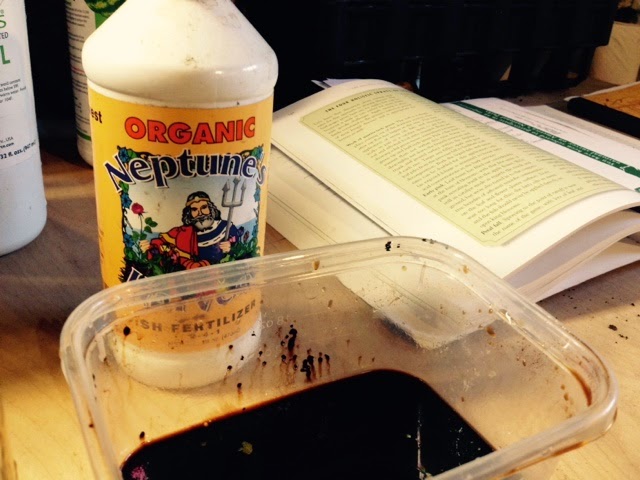
  • 5 oz fish emulsion (I used Neptune's Harvest)
  • A few teaspoons kelp powder
  • 1.25 oz pure neem oil with about 1/2 tsp soap as emulsifier (high quality, fair trade, OMRI approved neem sources available here)
  • Some garlic water I made by soaking 2 crushed cloves overnight (this isn't in his recipe but I had it in the fridge and thought it couldn't hurt since garlic is anti-fungal)
Another key ingredient in Phillip's sprays is effective microbes, good microbes that colonize the tree's surface and prevent fungal invasion, but I'm still waiting on that to show up in the mail, so I'll respray once they arrive. SCD Probiotics is a reputable company Phillips recommends to buy effective microbes.  

Arkansas Black planted last spring about to bloom
Fish emulsion and seaweed powder for apple tree spray
Want the cheat sheet to Phillip's methods?  Check out his helpful tips here:  Seasonal Checklist for the Holistic Orchard

NEST BOX UPDATE
Another spring happening is improved nesting boxes for the chickens.  I dropped some cash for a high quality, 4 hole nesting box from Kuhl that hangs on the coop wall.  The bottom of each box pops out if there is ever a broken egg in the box, or for general cleaning, and there are no nooks and crannies for mites to hide.  Plus, it's easy to detach from the coop and give a good cleaning once in awhile, unlike wooden boxes.  The milk crates worked as nesting boxes for a year, but this is a big improvement.  It's lightweight but fairly durable, and the eggs are staying much cleaner for some reason.  I'm not sure why that is, but I won't complain.  Clean eggs and mite-free chickens makes me like these boxes a lot!

Kuhl Metal hanging nest boxes 


Monday, November 10, 2014

What's Happening In The Garden This Week

We got a break from the chilly weather with a gorgeous day in the 60s today.  After a walk with Ida the Dog in Frick Park, I was gardening til the sun set just now.  Most things are mulched and tucked in for winter, except the greens that are still growing under cover.

Stayman Winesap apple tree in foreground and 2 beds covered with hoops and row cover for fall and winter harvests.
I have picked up a nugget or two of wisdom from all the expert gardeners I have read about.  One of those is keep your soil covered!  Winter winds and rains erode and compact soil, and the sheet mulch beds that we made this spring are indeed covered.  2 beds got seeded with winter rye, which grows in the fall, overwinters, and then grows in the spring.  We will mow it down and fork it in, or let the chickens finish killing it 1 month before summer planting.  Planting in a rye bed sooner than that is asking for poor germination, as the plant puts out chemicals that inhibit germination.

Winter rye in some of the beds

Soil that isn't covered with rye is mulched with straw or dead plant material.  I like the way the straw makes the beds look.  It tidies everything up a bit.  

An old mailbox becomes a garden toolbox for trowels and gloves
This horehound and Aronia (below) are part of a mixed planting of shrubs, trees, herbs, and berries that I would like to become a screen of sorts from the road and neighbor's house.  Its about a 4' wide swath of plantings along our front and side fencelines, and I have a mix of all kinds of things going on.  I have my culinary herbs in a border of sorts closest to the house: oregano, marjoram, thyme.  I have Aronia (a berry shrub rich in antioxidants), Nanking Cherry (These are doing terribly and will need a boost of compost, worm castings, and rock fertilizer in spring), Serviceberry, Paw Paw (the site is too sunny for these trees ideally but they are an experiment here.  I also have them planted in a different spot with dappled sun that they should prefer), comfrey, borage, fig, 3 apple trees (Stayman Winesap, Zestar, Arkansas Black), hazelnuts, and flowers.  It has been great fun to see these things grow this season.  All have been slow, but I think next year, we will see some real growth!

Horehound, a medicinal herb (left) and Aronia, a berry shrub (right)
2 of the 4 hazelnuts I planted are still kicking.
I've read hazelnuts yield the most when grown as a single stem form.  Since part of the job of these plants is to form a "hedgerow screen", I plan to let them just grow wild, no pruning required.

My gaudy New England Aster is still blooming and the bees love it.  Aster actually produces more bee food after frosts hit.
A young buck made it into our yard a few days ago.  We hung up some streamers from the fence to discourage him from jumping in again, although he was so freaked out by being in the yard, he didn't eat anything and promptly jumped out again.  This is the time of year we expect them to make their moves in, so we will just have to see how it goes.  I plan on planting some diversion plants on the outside of our fence in the back.  As far as other munchers, I know we have a lot of voles around here because I see them running around.  The chickens catch some of them, but I protected my apple tree trunks from the ones that the chickens can't get to.

Rodent Guard around apple tree trunk.  Rodents love to chew tender bark.
I rarely sit and relax in the garden.  It doesn't feel quite private enough for that yet.  But I do sometimes sit on this little bench I found.

My little garden bench, found on garbage night in Edgewood.
Asparagus ferns starting to die back
I love this Sweet Bay Magnolia, grown by our friend Nick and purchased from Tree Pittsburgh.  Now, it has a fancy belgian block ring round it!
Lil kitchen herb garden by the back door

Raspberries

Sunday, October 12, 2014

Whats Happening in The Garden This Week?

It is a beautiful Sunday here with an expected high of 68 degrees.  A hard frost has not hit us here in the Pittsburgh area yet, giving me extra time to get the garden ready for the cold and cover my beds with hoops and row cover for season extension.  

The leaves are beginning to change on the trees behind our house, and the cold nights leave a chill in the air for morning activities.  Mulch is the word of the day.  Organic material coming out of the beds from summer crops either goes to the chickens or gets laid directly on the soil as mulch and then covered with straw for a tidier appearance.  In my commute to work or the store, I am on the lookout for leaves and brush that has been put out to the curb.   I am ready to pick them up - leaves for chicken bedding and brush to add to our pile for when we borrow our friend's chipper.  Wood chips will go to mulch perennial areas and to some paths.  

I have also sowed some winter rye on the empty beds that have been cleared as a winter cover crop, and finally made some rodent guards to keep the apple trees safe from those that would want to gnaw their bark.  

Sheet mulch beds from this spring with their fall crops
Misato Rose Fall Radish coming along nicely and Danvers carrots.  These will go under cover.

Red Russian kale, arugula, various asian greens, and lettuces destined to be covered for winter,


Butternut Squash Patch.  Yield is 40 squash from 4 plants.

Asparagus bed with kale, herbs, and volunteer amaranth.
Straw mulch and 1/4" hardware cloth rodent guard to protect the young apple trees' bark from gnawing teeth,

Monday, May 12, 2014

Apple Trees: Stayman Winesap, Arkansas Black, and Zestar

Stayman Winesap
Zestar
Arkansas Black

As a follower of Apple Man Michael Phillips, and an inexperienced tree fruit grower, my plan was to wait a year to plant apple trees and work on helping our soil become wonderfully rich, full of life, and apple-friendly.  I was going to do this with cover cropping, compost, and woody debries to create a fungal-dominated soil that trees like.  Instead, I ordered 3 apple trees and plunked them in our phosphorus and potassium deficient soil with no more than a handful of worm castings and a little mycorrhizal fungi on their roots to help them take hold.  Oops.  I'm adhering to the "don't amend the planting hole with anything" train of thought.  I did make a large 3' diameter hole for them and broke up the sides of the hole with a garden fork.  My theory is I can feed them with love and organic matter from the top down.  Several large apple trees in the vicinity give me hope.  Best of luck to them.

I ordered EMLA 111 rootstock, a semidwarf rootstock that is good at anchoring (since we are on a windy hillside).  I mail ordered from Boyer Nursery in Biglerville, PA and was quite happy with the trees.  This is what Boyer Nursery says about the rootstock on their website:

EMLA 111
Semi-Dwarf, Zone 5-8 (Northern Spy x Merton 793)
Mature Height 18-22ft. with recommended 16-26ft. spacing.
It is an outstanding choice for spur-type Red Delicious varieties.  It has an excellent anchorage, with no staking required.  Very drought tolerant, high soil temperatures and adapts to sandy and clay loam.  Best Semi-Dwarf for heavy or poorly drained soils.  Quite resistant to collar rot and Woolly aphids, and moderately resistant to fireblight.  Can be susceptible to burr knots and powdery mildew.  Rarely produces root suckers.  EMLA 111 produces an early and prolific fruit crop.  

A tree planting, pruning, and growing novice, I spent much time watching youtube videos of different pruning styles and reading extension fact sheets on trees.  I realized I had on my hands feathered maidens (how lovely!) not 1 year old whips (which look like sticks).  I spaced them 16' apart.  I did know enough to get trees that have overlapping bloom times so they can pollinate each other.

In the end, after planting, I pruned them back to no more than 3 - 5 branches that had decent crotch angles and pruned those back to an outward-facing bud so they were shorter than the central leader.  I also mulched with pea-gravel.  After reading well-written arguments that improperly staking trees can lead them to never develop strong root systems, I drove in a single short stake intended to be cut off after 1 season.  I don't think they would need staking in a more sheltered planting site, but our hill sure does get some wind.  Still to do is putting up some hardware cloth guards to protect the trunks from rodent-nibbling and weighing down a few branches that need wider crotch angles.    So, that is the plan for them, and they are leafing out as I write.

I am attempting a bit of a hedgerow of trees, shrubs, flowers, herbs, and the like, similar to the ideas in this article from Permaculture Magazine...Replanting Hedgerows.  If it fills in quick enough, perhaps it can keep the deer from feeling comfortable in jumping over at least some sections the fence.  If it doesn't, we need to formulate a deer-diversion plan.  I planted the apple trees in 4' from the fence, and I got that number from Phillips' recommendation for building deer cages around your apple trees.

In any case, our soil where both where the trees are planted and where we plan to plant vegetables is deficient.  I know this from our UMASS Amherst soil test.  I have not purchased any rock phosphate or greensand, but I am haphazardly dumping different forms of organic matter and composted chicken manure on top of cardboard or newspaper sheet mulch style to slowly improve our soil (hopefully).  C'mon worms, incorporate it!  A local coffee shop has offered to supply us with spent coffee grounds and coffee bean chaff from roasting (surprisingly not acidic).  We shall see if our soil improvement on the cheap works.

Coffee Bean Chaff

Monday, September 3, 2012

First Apple


That's right...our first apple.  From the tree our friends gave us.  So proud of the lil (bug free!) bugger.


Thursday, July 21, 2011

Time for Garlic and Wineberries


Costata Romanesco zucchini (the best...has a nutty flavor!), Benning's Green Pattypan Squash and some pickling cukes.


Rubus phoenicolasius, or wineberry, grows wild and crazy in the back of our garden lot. The spiny canes produces very juicy, delicate berries for just a few short weeks. Farewell, wineberry.


Jason is flabbergasted by delicious garlic fumes.

Garlic going for a rest.

Czech Black Pepper. So showy. So nice.